Electrical tests serve a specific technical purpose: ensuring the reliability, safety, and compliance of materials, components, and assemblies of components. This test panel enables an in-depth analysis of the electrical behaviour of equipment at all stages of its operation.
Short-circuit
Short-circuit testing purpose is to verify of the ability of switchgear or of a system to withstand electrodynamic forces.
Both switchgear (circuit breakers, contactors, cables, etc.) and complete systems (electrical cabinets, enclosures, etc.) can be tested to verify their behaviour during withstand, closure, or breaking or opening tests
Station performance is as follows:
• 100 kA at 440 V 50 Hz 100 ms.
• 100 kA at 230 V 50 Hz 100 ms.
• 65 kA at 690 V 50 Hz 100 ms.
The various tests proposed on the short-circuit station include, among others:
• Conditional short-circuit capability test.
• Short-duration withstand test.
• Internal arc test.
To carry out short-circuit tests, two separate equipment are used to Together generate the short-circuit energy. Here are the asynchronous characteristics :
• Drive motor: A 500 kW electric motor
• Alternator: Coupled to the motor, it has a capacity of 5.3 kW and can deliver up to 28 MVA of apparent power
The capacitive discharge bench
It is used to define the short-circuit withstand and closing performance of DC protection systems, when the short-circuit currents are very high.
Short-circuit levels can be adjusted to simulate those of storage devices, fields of photovoltaic panels, DC sources, etc.
Thanks to this capacitive bench, we can generate very low time constants, from 0.1 to 0.3 ms, in order to reproduce a rapid capacitive discharge.
Test bench performance is as follows:
Maximum voltage: 1500 VDC
Capacitance: 125 mF
Max. di/dt: 200 A/µs
Max. current: 200 kA
Electrical Endurance
Electrical endurance tests are performed to verify the ability of equipment/switchgear to make and break voltage and current, under normal or overload conditions.
These tests are essential to validate the electrical service life of devices, identify critical wear points, and ensure their compliance with international standards.
The laboratory has 3 rooms for electrical overload and endurance tests, enabling the testing of various types of equipment:
- At a rated current with a high number of operations.
- Under overload conditions (between 1.5 and 10 times the product’s rated current depending on the test characteristics).
The different characteristics of the stations are as follows:
- Up to 1500 V 10 kA 1 s in DC.
- Up to 1100 V 8 kA 1 s in three-phase 50 Hz AC.
Temperature rises tests
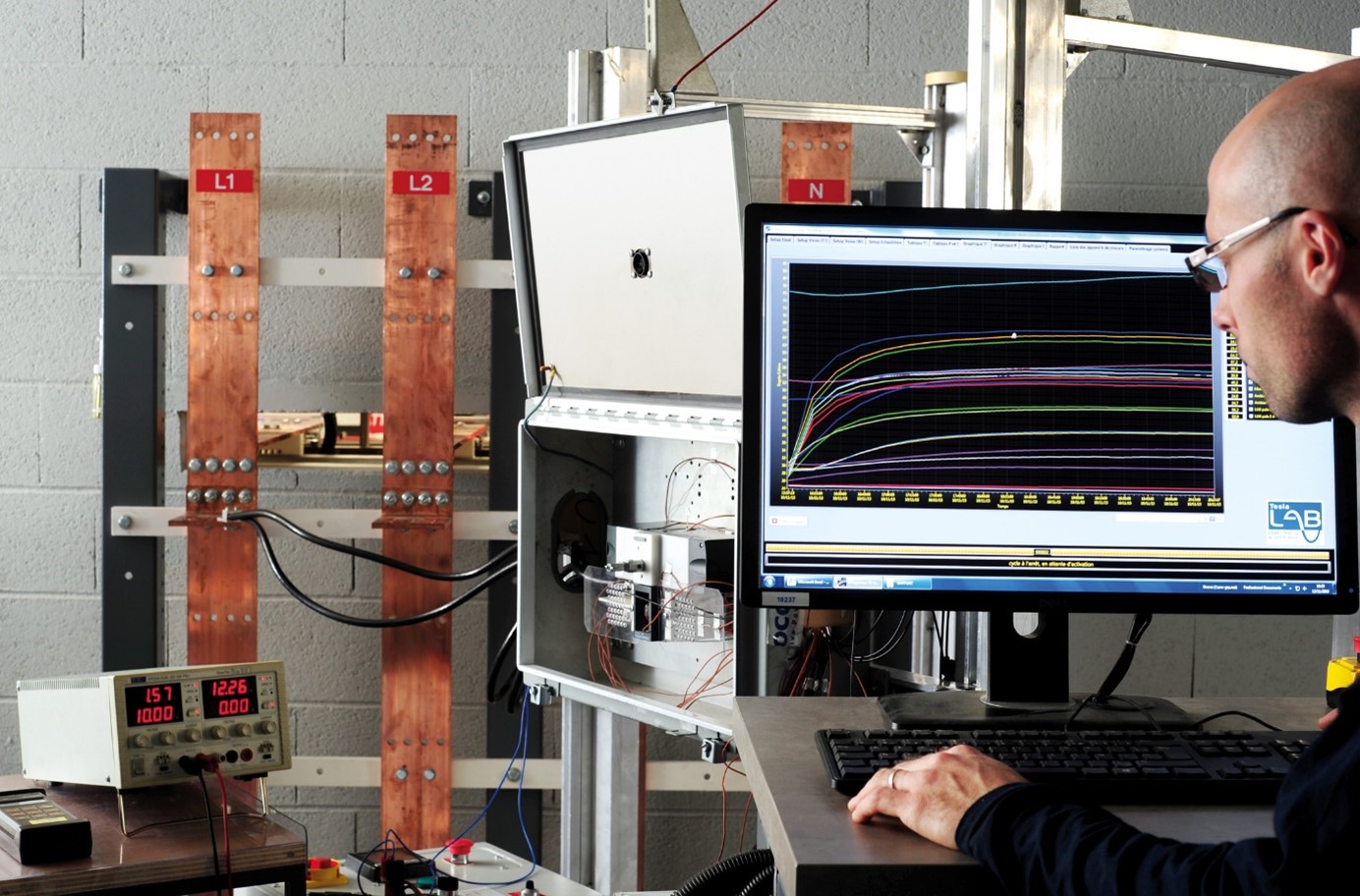
The purpose is to monitor and record temperature-rises on an equipment when is crossed by an electrical current flow (Joule effect). The results obtained may be used to determine the power loss of the installation or switchgear.
The laboratory temperature rise test facilities enable testing of all types of electrical equipment, ranging from a single device (circuit breaker, contactor, thermal relay, etc.) to a distribution cabinet. Furthermore, it is possible to test these installations in an enclosure that can reach an ambient temperature of 55°C or 70°C, depending on the size of the equipment in question.
It is also possible to simulate loads from different circuits of a low voltage switchboard, up to 29 distinct circuits of the same equipment, with various current values ranging from 1 A to 3,200 A for each of them.
The different types of test facility:
4 temperature rise rooms (very low voltage current sources):
- Room 1: 1250 A (single-/three-phase 50 Hz) source
- Room 2: 3000 A (single-/three-phase 50 Hz) source
- Room 3: 6000 A AC (single-/three-phase 50 Hz) and DC source
- Room 4: 12,000 A (10,000 A permanent) AC (single-/three-phase 50 or 60 Hz) source
“Zenone” sources:
Programmable current sources from ZENONE are capable of delivering current in AC or DC. They are mainly used for temperature rise tests and enable performance of all types of tests requiring a stable current and/or a measurement of the current passage time.
Characteristics of the sources:
- AC current range: 5 A to 1000 A
- DC current range: 36 A to 353 A
Safety of electrical and electronic devices
Electrical safety tests are used to ensure that devices do not compromise the health and safety of people or facilities by verifying their compliance with the both Low Voltage Directive and electrical safety standards.
Various tests are proposed to verify the electrical safety of switchgear:
• Surge immunity to 1.2/50 µs voltage waveform, enabling simulation of disturbances generated in the power grid.
• Industrial frequency withstand test enabling verification of dielectric strength between different parts of switchgear or its environment.
• Leakage current measurement to ensure that an electrical device will not cause an insulation fault in electrical installations.
• Insulation resistance measurement to check the quality of insulating parts between different potentials of energized equipment.