To ensure the reliability of equipment in real-world operating conditions, it is essential to test their resistance to extreme or unusual environments and to conduct accelerated aging tests on the devices in order to guarantee their operation during their lifespan. At Tesla Power Lab, we implement a full range of tests to simulate certain physical and environmental constraints.
Climatic tests
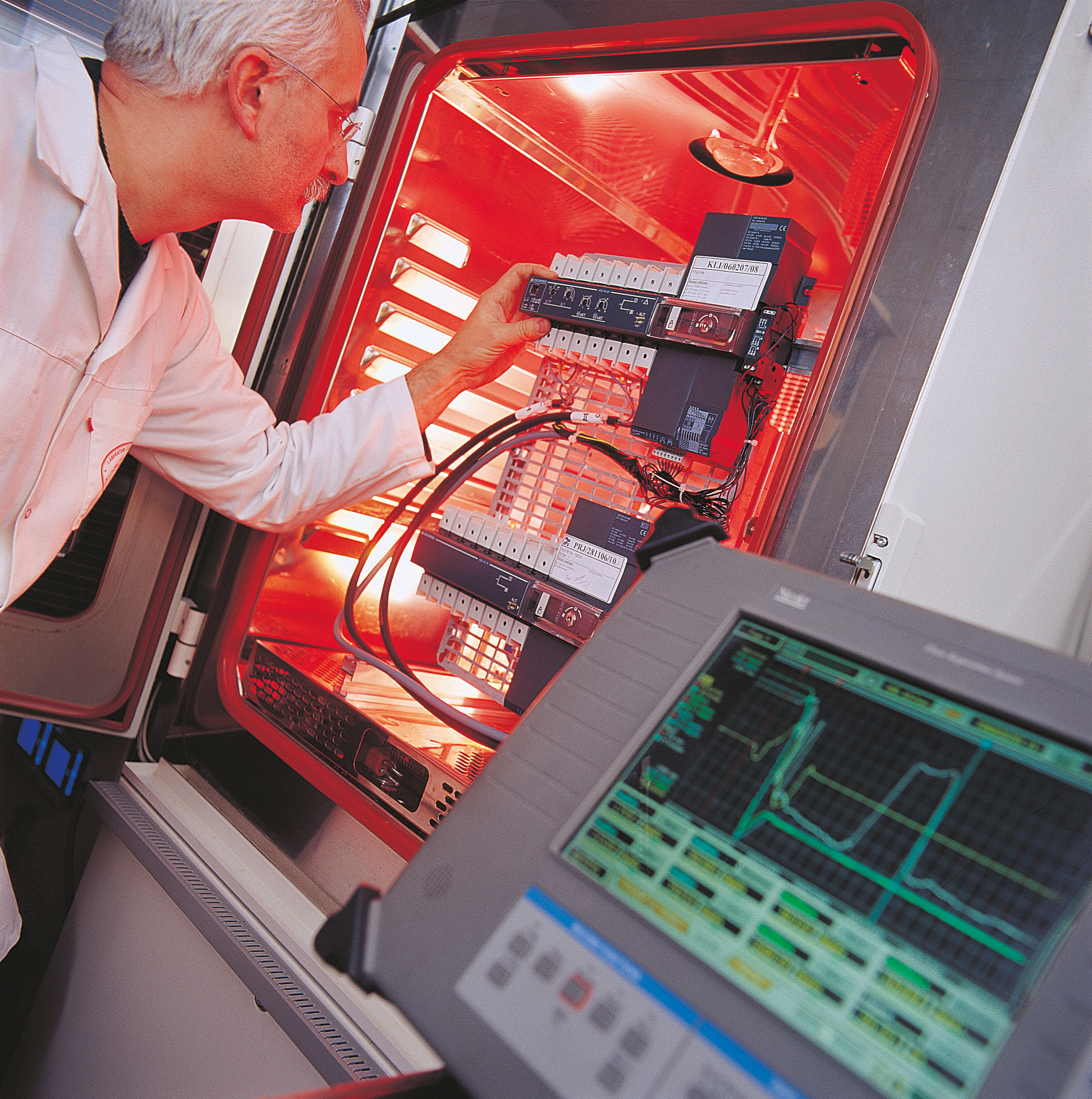
Several climate chambers are used to assess the performance and durability of products when subjected to severe environmental conditions such as temperature and humidity.
It simulated the real conditions that products might encounter over their lifespan.
The test facilities:
The thermal shocks chamber enables rapid variations of temperature between two distinct volumes of the same chamber:
Temperature Variation Range: -80°C to +220°C
Acceptable dimensions: W: 380 mm ; D: 430 mm ; H: 370 mm
Climate chambers are used to vary both the temperature and humidity.
Temperature Variation Range: -50°C to +180°C
Humidity Range: 25% to 97% RH
Internal dimensions: W: 580 mm ; D: 765 mm ; H: 750 mm
Ingress Protection verification
These tests are used to verify the degree of protection provided by enclosures and enclosure accessories (external handles) against ingress of water or dust and against foreign solid objects, according to the IEC / EN 60529 standard.
The various tests verify the degree of protection ranging from IP11 (enclosures protected against foreign objects greater having a diameter ≥50mm and against vertical fall of waterdrops) up to IP66 (protected against dust ingress and powerful water jets).
Solid object Ingress protection
Solid object ingress protection tests, like water ingress protection tests, are used to verify the degree of protection provided by enclosures in accordance with IEC/EN 60529 against access to hazardous parts:
Ranging from IP1X (access with the back of the hand) to IP6X (access to the hazardous part with a wire).
and against foreign solid objects:
From IP1X (diameter ≥ 50mm) to IP6X (dust-tight).
Mechanical Endurance
Mechanical endurance testing purpose is to verify the mechanical properties and/or the mechanical aging of the tested switchgear or equipment.
The tests are carried out by performing a large number of operations (opening/closing), in no-load conditions.
In addition, a large-capacity climate chamber enables mechanical endurance tests to be carried out under abnormal temperature conditions ranging from +80°C to -35°C, with an acceptable volume of 16 m³.
The various controls for mechanical endurance tests:
• Manual control (handles / rotary knobs or lever, crank)
• Electrical control (contactors, relays, motorized blocks, etc.)
• Simulation of an external control (with handle axis)
Vibration and mechanical impact tests
The vibration test purpose is to assess the durability of equipment subjected to the vibrations or impacts that may be encountered in the environment around the electrical installation (marine, railway, sifting applications, etc.).
The different types of test are:
• Search for resonance frequencies,
• Endurance at the resonance frequency,
• Shocks tests
IK impact protection tests verify the impact resistance an object hitting an enclosure (empty of fully equipped with switchgear and control gear), enabling simulation of being dropped or of deliberate or accidental mechanical damage.
The test methods are as follows:
• Vertical hammer: vertical drop of a mass onto a horizontal surface
• Pendulum hammer: movement of a mass, placed at a given distance from its axis of rotation, striking a horizontal surface
Glow-wire tests
The glow-wire test consists of exposing a material to the heat of a metal wire heated to a specific temperature (between 500°C and 960°C) in order to assess its resistance to abnormal heat and its reaction to fire. The hot wire, heated to the desired temperature, is brought into direct contact with the sample.
Purpose of the tests:
- Verification of the test sample resistance to abnormal heat (deformation, melting, sublimation),
- Observation of its behaviour in the event of a fire (flame-spreading, self-extinguishing).